Project Guides
Faux Alabaster vs. Natural Alabaster Lighting: A Project Buying Guide
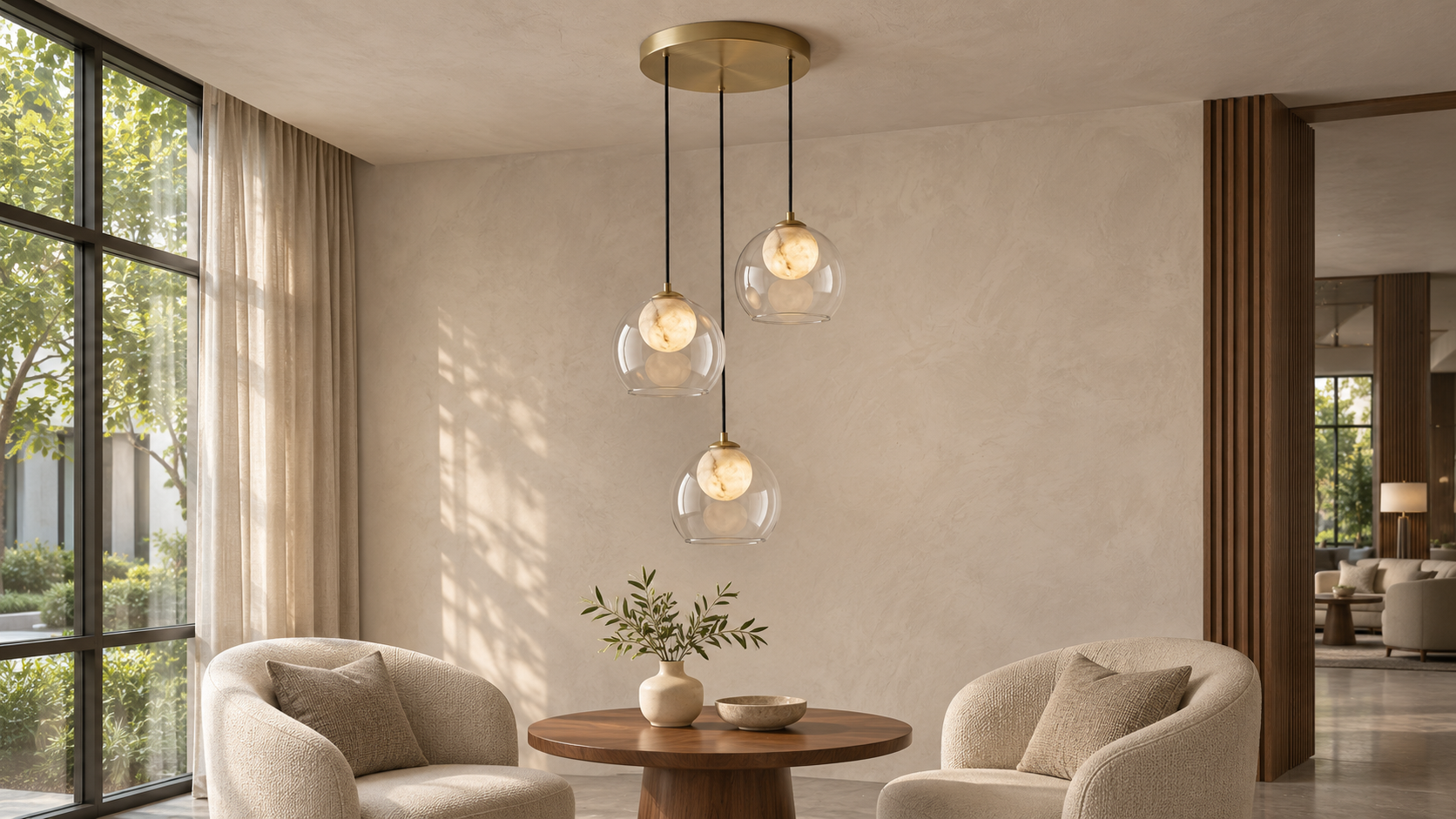
Scene illustration
Natural alabaster lighting uses quarried stone; faux alabaster lighting uses a manufactured material intended to create an alabaster-like appearance. Neither label alone tells a hotel or villa project team the finished light output, fixture weight or maintenance requirements. Compare the specified material and a working sample before choosing a decorative pendant or chandelier.
First establish what the shade is made from
For this comparison, natural alabaster means gypsum alabaster. The US National Park Service describes it as fine-grained gypsum and notes its translucency, softness and sensitivity to moisture. Ask the supplier to identify the actual stone rather than relying on a photograph or the word “alabaster” in a colour description.
Faux alabaster is an appearance category, not a single material specification. Request the composition of the proposed shade or diffuser, including any coating, printed layer or backing. Lumicor's Alabaster décor, for example, reproduces a stone appearance in resin panels with an additional opaque or semi-opaque layer. That is evidence of one manufactured approach, not a specification for every faux alabaster lamp or for Meiyun's products.
A clearly disclosed imitation is a legitimate design option. The purchasing problem arises when an alabaster-effect component is sold or approved as natural stone. Put the agreed material description into the quotation, sample approval and final order so an attractive visual reference does not become an ambiguous purchase.
Compare the look in two states
Review natural and manufactured options both switched off and illuminated. For natural stone, discuss the acceptable range of veining and tone across the supplied pieces. For the faux alternative, ask whether its pattern is printed, cast or produced by another method and inspect more than one sample when repeated pendants will be seen together. A pattern that looks convincing in one close-up may be judged differently across a hotel dining area.
Do not assume natural stone always gives softer light or that an imitation must look flat. Compare working samples with the intended light source, dimensions and finish. Ask for product-specific photometric information if the decision depends on delivered illumination. The appearance of the diffuser is not a substitute for the lighting designer's assessment of the room.
Weight, price and service life need separate evidence
Compare the complete fixture weights and mounting requirements for the selected configurations. A material name does not provide the mass of the frame, the shade thickness or the number of components. Avoid applying a universal weight ratio between natural and faux alabaster, particularly when the two proposed luminaires have different geometry.
Likewise, obtain like-for-like quotations covering the same size, metal finish, electrical configuration, quantity and packing scope. Natural stone and manufactured alternatives involve different material and processing choices, but that does not establish a fixed price premium. An inexpensive sample or a premium material name also cannot establish the expected service life of the installed fitting.
Cleaning and suitability belong in the specification
The National Park Service's conservation guidance warns that gypsum alabaster is vulnerable to water and abrasion. Use that as a reason to request written care instructions for the finished luminaire; the guide concerns stone objects and does not certify any lighting product. Do not test a purchased shade by scratching it, soaking it or applying chemicals to prove authenticity.
For a faux component, ask for the manufacturer's cleaning instructions and any evidence relevant to heat, UV exposure and the intended environment. Do not transfer a resin-panel supplier's properties to a different shade material. Neither “natural” nor “faux” automatically makes a complete luminaire suitable for bathrooms, outdoor locations or every destination market.
Which option fits a hotel, resort or villa?
Choose natural alabaster when verified stone identity and the approved range of natural character are central to the design brief, provided the selected fixture also meets the project's installation and care requirements. Consider a disclosed faux alternative when its approved appearance, composition and documented performance meet the brief. Repeated-room procurement still needs agreed acceptance criteria whichever route is chosen.
For a bespoke lighting enquiry, give Meiyun the reference design, intended material identity, dimensions, quantity, destination and application. Zhongshan Meiyun Lighting Co., Ltd. supports custom decorative lighting through engineering drawings, material-sample approval and pre-assembly testing. Confirm the available material and technical configuration for the specific model rather than assuming every reference design can be supplied in both materials.
Before approving either option
Request a written material declaration, representative unlit and illuminated samples, complete fixture weight, care instructions, applicable product documentation and an aligned quotation. For the wider approval sequence, see our custom lighting production process guide. The application image accompanying this article illustrates a design setting; it is not proof of material composition or a measured comparison of two lamps.