Project Guides
Custom LED Lighting: A Dimming Group Is Not a Driver Group
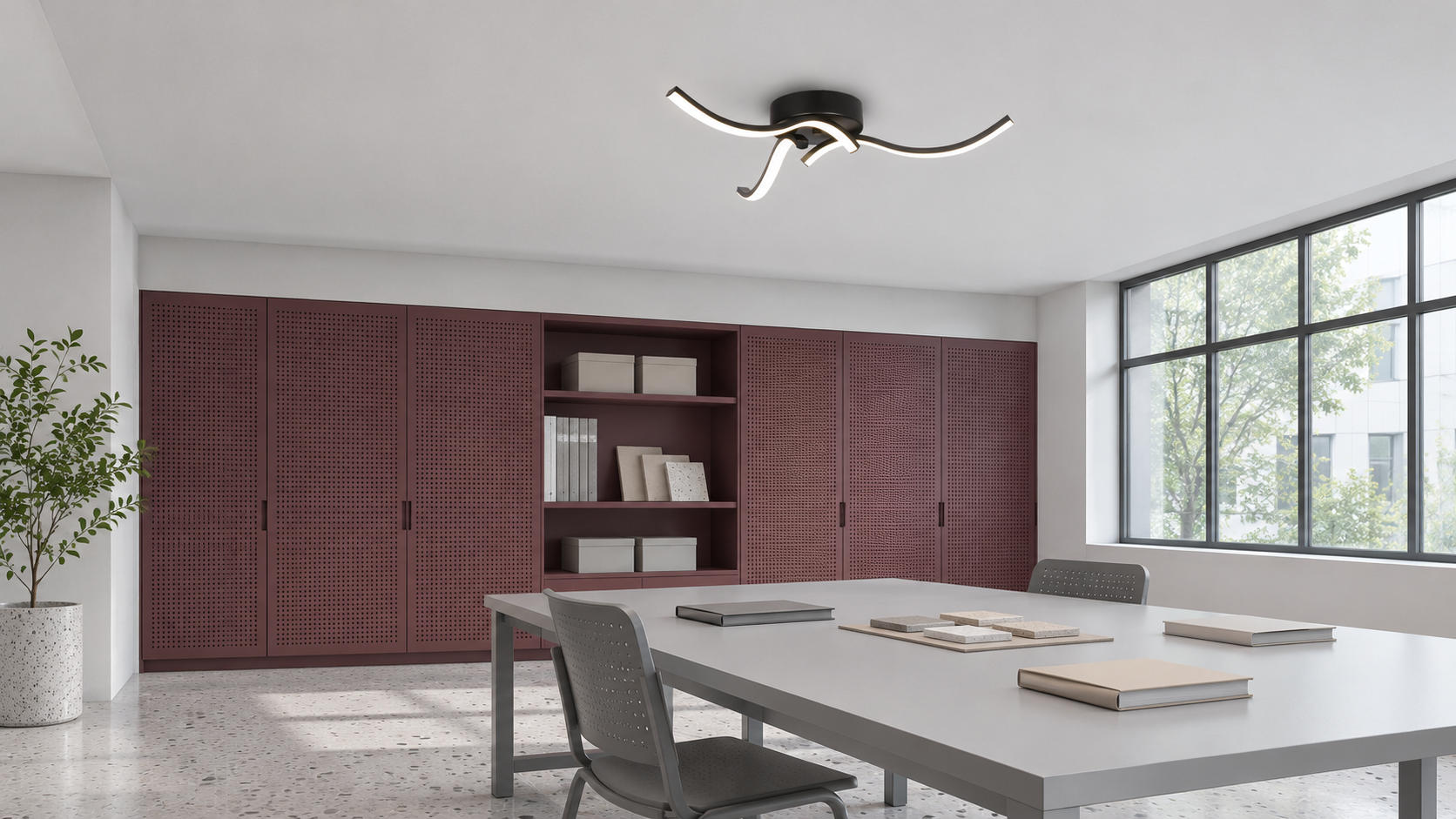
Scene illustration
Several decorative light elements can dim together without sharing one LED driver. For custom lighting procurement, ask for the control grouping and the power arrangement separately. The first describes which elements respond together; the second helps explain which elements depend on the same equipment. A successful scene demonstration does not answer both questions.
What does “one group” actually mean?
A designer might ask for every illuminated element in a ceiling composition to fade together. Procurement then receives a proposal described as “one dimmable group”. That phrase may describe the intended user experience, but it does not identify the number of drivers, the elements supplied by each driver or any shared equipment upstream.
The distinction is visible in the DALI Alliance's recommended terminology: a DALI group is a collection of control gear or control devices. It is a control relationship, not a statement that all the lights receive power from one driver. DALI is an example here, not a requirement for every project or a claim that every Meiyun fixture supports that system.
For the project team, the useful next question is therefore not simply “does it dim?” Ask which physical components sit behind the accepted group behaviour. An interior rendering shows luminous shapes. A controls schedule describes commands. Neither alone establishes the dependency between a particular driver and the light elements it supplies.
Compare two arrangements with the same visual result
Consider a hypothetical composition with six illuminated elements. In one proposed architecture, a common driver supplies all six. In another, several suitable drivers supply separate subsets, while the control system commands them together. These are conceptual alternatives requiring a manufacturer's engineering review, not wiring options that can be applied to an arbitrary fixture.
The room could appear similar during an ordinary dimming demonstration. However, if every element relies on a common driver and that driver stops supplying power, all of those dependent elements can lose light. With separate drivers, the directly affected subset may be smaller. Shared upstream supplies, controls and protection still matter; several drivers do not automatically make the complete installation independent or fault tolerant.
This observation does not rank one arrangement as universally better. It identifies a trade-off the buyer should understand. Driver count, available space, access, component compatibility and the accepted design all need project-specific evaluation. Do not turn a preference for a smaller affected group into an unreviewed request to divide the manufacturer's electrical assembly.
Map dependencies before comparing maintenance plans
Give the illuminated elements identifiers on the proposed arrangement. Ask the manufacturer to connect each element identifier to the driver reference that supplies it. Keep those references distinct from the control-group names used by the controls contractor. If the same controller or supply serves several groups, record that shared dependency as well.
Then ask a bounded question: if this identified driver were unavailable, which decorative elements would be affected? The answer should refer to the proposed assembly, rather than promise that a certain number of drivers prevents every outage. It is a design review of dependencies, not a diagnosis of an installed fault or a reliability prediction.
The U.S. Department of Energy's Lifetime and Reliability fact sheet explains that drivers and other components, not only LED packages, can cause product failure. Its system perspective supports considering these dependencies. This historical guidance does not establish a failure rate, service life or warranty for a current Meiyun configuration; use current product-specific information for those claims.
Bring the operator into the grouping decision
For a hotel or commercial space, ask the operator what a partial loss of decorative light would mean in that setting. Would it visibly interrupt a continuous composition? Could the affected area be taken out of use for service? Which access arrangements would a repair involve? The answers help describe the operational consequence without pretending that the decorative fitting is an emergency-lighting system.
Separate repair scope from light output. Replacing a small driver may still require access to a shared ceiling enclosure, and separate drivers may remain behind the same decorative cover. Conversely, a clearly identified accessible assembly may make the intended service task easier to define. Have the actual access and replacement method confirmed by the responsible manufacturer and qualified project team.
Keep demonstration and documentation connected
During the agreed review, document which proposed elements respond to each command and retain the associated driver schedule. A normal operating demonstration confirms the observed response of that configuration; it is not a destructive failure test. Any diagnostic or service procedure belongs to qualified personnel following the product instructions and site requirements.
If a substitution changes the driver count or the element-to-driver mapping, review the dependency record again even when the finish, outline and normal dimming appearance remain unchanged. Ask whether the service arrangement and affected subsets have changed. A visually equivalent substitution can leave the operator with a different maintenance question.
What Meiyun needs from the project team
Meiyun Lighting manufactures bespoke decorative lighting with in-house LED assembly and supports engineering drawings, pre-assembly testing and factory inspection. Send the desired visual composition, operating groups, destination and maintenance priorities with the enquiry. Request the proposed driver arrangement and available control configuration for that specific order; these capabilities do not establish a standard architecture across every product.
Our guide to dimmable custom lighting addresses the interface between the fixture and the controls package. Add a separate question to that discussion: which light elements depend on which driver? Agreement on the user command and agreement on the power dependency are two different decisions, and both belong in a coordinated custom lighting proposal.