
Project Guides
Custom Lighting in the UK: A Designer’s Guide to Bespoke Lighting for Hotels, Homes & Restaurants
Introduction
Lighting has become much more than a functional element in contemporary UK interiors. In luxury residences, boutique hotels, restaurants, private clubs, retail spaces and commercial interiors, decorative lighting can influence how people experience the entire architecture. A chandelier can establish the visual centre of a lobby. A sculptural pendant can define a dining area. A wall light can emphasize a material surface. A carefully designed cluster of lights can create rhythm within a double-height staircase.
This is one reason custom lighting in the UK is increasingly important for designers, architects, hospitality brands and project contractors. Instead of selecting a standard fixture from a catalogue and trying to make it fit the room, bespoke lighting allows the fixture to be developed around the actual architecture.
1. Start With the Architecture Before Choosing the Fixture
Before developing a chandelier or pendant, the manufacturer should understand the architectural environment. Important information includes ceiling height, floor plan, furniture position, circulation paths, architectural axis, ceiling structure and viewing distance.
For example, a chandelier above a dining table should relate to the table dimensions, while a fixture in a double-height lobby needs to be considered in relation to the entire vertical volume. Custom manufacturing allows the overall diameter, height, suspension length and component spacing to be developed around the actual room.
2. Scale Is One of the Most Important Elements
A beautiful lighting design can still look wrong if its proportions are incorrect. This is particularly obvious in double-height staircases, hotel lobbies, large dining rooms, open-plan living rooms and reception areas.
Custom manufacturing allows designers to control overall diameter, overall height, number of light sources, decorative elements, drop length, distance between pendants, canopy dimensions and suspension configuration. This makes it possible to create a fixture that feels intentional rather than simply oversized.
3. Custom Lighting Is More Than Making a Fixture Larger
True bespoke lighting can involve changes to shape, material, finish, structure, lighting configuration and suspension. A manufacturer can adapt a silhouette to the architectural concept, develop different material combinations, create project-specific metal finishes, engineer the internal frame and adjust the number and position of light sources.
This means a custom lighting manufacturer can become part of the design-development process rather than simply a supplier at the end of the project.
4. Choosing Materials for UK Luxury Interiors
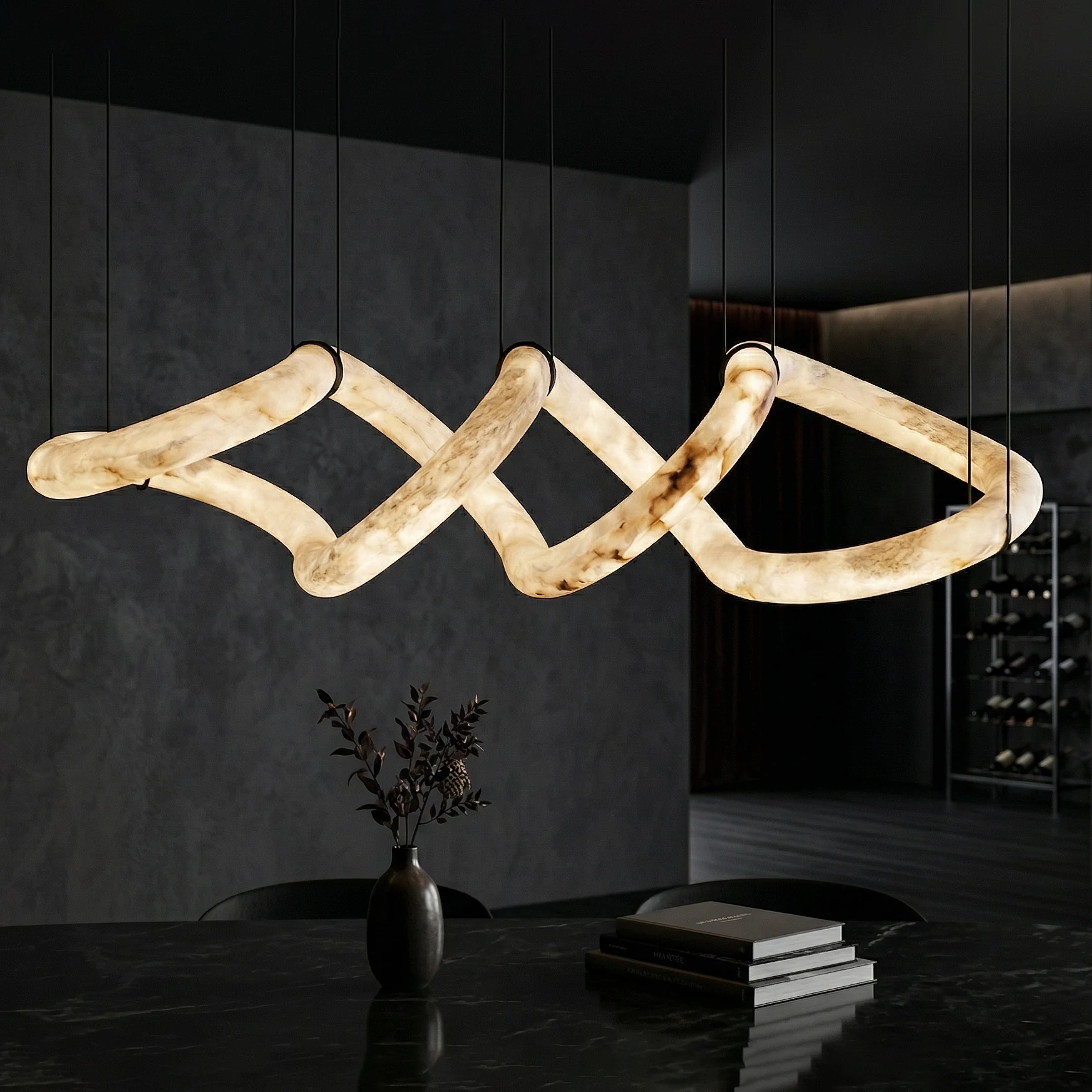
Alabaster can provide a soft diffused appearance, while marble and travertine create stronger architectural character. Glass offers flexibility through clear, amber, smoked, opal, textured and hand-blown options. Crystal can introduce sparkle and reflection, while metal can define the structural and visual frame.
For contemporary UK interiors, material combinations are often more effective than using a single material everywhere. A marble element combined with brushed metal, or hand-blown glass combined with a refined metal frame, can create a distinctive but controlled visual language.
5. Metal Finish Can Change the Entire Appearance
The same lighting structure can look completely different when the metal finish changes. Brushed champagne gold can create a softer warm appearance; polished brass provides stronger reflection; antique brass can suit heritage-inspired interiors; matte black creates contrast; bronze offers a deeper architectural character; mirror chrome gives a sharper contemporary appearance.
For custom projects, physical finish samples should ideally be approved because surrounding light and materials can change the perceived colour.
6. Design a Lighting Family Instead of One Fixture
Hotels and restaurants often need several decorative fixture types. A custom lighting family can use one design language across a lobby chandelier, restaurant pendant, corridor wall light and guest-room fixture.
The fixtures do not need to be identical. They can share a metal finish, glass shape, stone element, geometric detail or colour palette. This creates consistency across the project while allowing each space to have its own character.
7. Double-Height Spaces Need Special Attention
Double-height spaces are strong applications for bespoke lighting, including hotel entrances, duplex residences, grand staircases, villa entrances, restaurant atriums and showrooms.
Instead of creating one solid mass, designers can use multiple suspended elements. The overall composition can be controlled through drop lengths, component size, horizontal spacing, vertical spacing and ceiling position. Negative space around the fixture can become part of the design.
8. Engineering Should Start Before Production
A custom lighting project should not move directly from rendering to manufacturing. The engineering stage should consider overall dimensions, material specifications, component dimensions, suspension points, canopy dimensions, electrical configuration, LED specifications, driver requirements, installation method, weight distribution and maintenance access.
The visual design must be translated into a structure that can actually be manufactured, transported and installed.
9. Coordinate Electrical Requirements Early
Decorative lighting should be developed together with its electrical requirements. Depending on the project, the team may need to coordinate voltage, frequency, LED type, wattage, colour temperature, dimming, driver location, wiring and ceiling connection.
For UK projects, the applicable electrical and building requirements should be checked by the project team and relevant professionals before final production.
10. Why Physical Samples Matter
Digital renderings are useful for communicating a concept, but physical samples are especially valuable for natural stone, glass, metal finishes, crystal and textured surfaces.
A sample allows the designer to assess colour, texture, transparency, surface quality, light transmission and reflection. For larger projects, an approved sample can become the visual reference for subsequent production.
11. Quality Control for Bespoke Lighting
Quality control can include dimensional inspection, surface inspection, structural inspection, electrical testing, assembly inspection and visual comparison with approved drawings and samples.
For repeated fixtures, production drawings and approved samples help maintain consistency. For complex projects, documented inspection can also improve communication between the manufacturer, designer, buyer and contractor.
12. Packaging Is Part of the Manufacturing Process
Large chandeliers may contain dozens or hundreds of components. Packaging should therefore be considered during engineering. Glass, stone and metal surfaces require suitable protection, while components should be numbered and packed according to the installation sequence.
Clear packing lists and installation drawings can reduce confusion when the project reaches site.
13. Custom Lighting for UK Hotels
Hotels are one of the strongest applications for bespoke lighting. Custom fixtures can be developed for entrance lobbies, reception areas, restaurants, bars, ballrooms, corridors, guest bedrooms, suites, staircases, lounges and spas.
A hotel can use a custom glass-and-metal chandelier in the lobby and repeat the same glass shape in smaller bedside pendants. This creates a visual story throughout the property without making every fixture identical.
14. Custom Lighting for UK Restaurants
Restaurant lighting needs to create atmosphere while working with the interior concept. Custom pendant groups can be designed above dining tables, bars, reception counters and private dining areas.
A combination of decorative chandeliers, wall lights and smaller accent fixtures can create different layers of light and help define individual zones.
15. Custom Lighting for UK Residential Projects
Luxury residential projects require fixtures that feel personal and integrated with the home. Common applications include entrance chandeliers, dining-room pendants, living-room sculptural fixtures, staircase clusters, bedroom pendants and dressing-room lighting.
Custom manufacturing allows each fixture to be developed around the actual dimensions and architectural character of the home.
16. What a UK Buyer Should Send to a Manufacturer
Useful starting information includes reference images, CAD drawings, 3D files, dimensions, quantity, material, finish, electrical specification, target market and project schedule. The more project information available at the beginning, the easier it is to assess feasibility and prepare an accurate quotation.
17. Expanded Section: Elevating British Interior Spaces with Meiyun Lighting’s Signature Collections
For interior designers, architects, and property developers across the UK, sourcing the ideal lighting fixture goes beyond mere illumination—it is about curating an atmosphere. Whether designing a period Georgian townhouse in London, a contemporary penthouse overlooking the Thames, or a boutique countryside hotel in the Cotswolds, lighting serves as the emotional heartbeat of the space.
Why Bespoke Lighting Matters in the UK Market
Heritage Meets Modernism: The UK architectural landscape is uniquely diverse, seamlessly blending Victorian and Edwardian historic structures with ultra-modern architectural builds. Meiyun Lighting specializes in bridging this gap, offering flexible customisation that respects historical context while delivering sleek, modern functionality.
Acoustic and Visual Balance: In modern open-plan British residences, grand chandeliers and multi-tiered pendant arrays do more than light a room; they anchor vaulted ceilings, partition vast volumes, and soften hard architectural lines.
Energy Efficiency and Smart Integration: Tailored manufacturing allows for seamless integration with modern UK smart home systems (such as DALI, Lutron, and phase-cut dimming), ensuring that luxury aesthetics never compromise on energy efficiency or regulatory compliance.
Meiyun Lighting’s Tailored Solutions for UK Projects
Bespoke Chandeliers for Grand Entrances: Engineered specifically to match the structural weight capacity and vertical scale of high-ceiling British properties.
Hand-Blown Glass & Alabaster Accents: Sourced and crafted to complement the neutral, sophisticated palettes popular in contemporary UK interior design.
End-to-End Technical Support: From initial CAD drawings and 3D prototyping to strict electrical compliance checks and secure modular packaging designed for international transit.
18. What Meiyun Lighting Can Provide
Zhongshan Meiyun Lighting Co., Ltd. specializes in custom decorative lighting and supports OEM and ODM development for international projects. The company can work from CAD drawings, engineering drawings, 3D models, sketches, reference photographs, designer concepts and existing product samples.
Material capabilities include marble, alabaster, travertine, glass, crystal, metal, rattan and other decorative materials. The process can include design review, engineering, material selection, finish confirmation, sample or prototype, production, quality control, packing and delivery.
19. The “Made in China” Advantage: Zhongshan’s Manufacturing Ecosystem
When sourcing bespoke lighting for UK projects, partnering directly with a Chinese manufacturer offers distinct strategic advantages. Located in Zhongshan, Guangdong—globally recognized as the capital of lighting manufacturing—Meiyun Lighting leverages an unparalleled supply chain. This robust ecosystem allows for rapid material sourcing, from premium metals to specialized glass and natural stone. The “Made in China” advantage today represents a seamless fusion of advanced CNC machining, rigorous quality control, and refined hand-craftsmanship. By working directly with a factory, UK designers and buyers benefit from transparent factory-to-project communication, faster prototyping, and highly competitive pricing without compromising the luxury standards required by high-end hotels and residences.
20. Why Work With a Custom Lighting Manufacturer?
Catalogue lighting can be efficient when the required size, material and specification already exist. However, a project may have an unusually high ceiling, a large dining table, a specific marble requirement, a unique chandelier diameter, multiple required sizes or a special metal finish.
These are the situations where custom manufacturing becomes valuable: instead of asking which existing product is closest to the design, the project team can ask how the design can be manufactured to fit the project.
Conclusion
The best custom lighting is not necessarily the largest or most complicated fixture. It is the fixture that feels as though it belongs in the architecture.
For UK hotels, restaurants and residential projects, successful bespoke lighting depends on correct proportion, material quality, controlled finishes, good engineering, appropriate illumination and consistent production. Custom lighting gives designers greater control over all of these elements.
Frequently Asked Questions (FAQ)
Q: What is custom lighting?
A: Custom lighting refers to fixtures developed or modified specifically for a project, including changes to dimensions, materials, finishes, structure, suspension and lighting configuration.
Q: Can I send a drawing to Meiyun Lighting?
A: Yes. Designers and buyers can provide CAD drawings, sketches, 3D files, reference images or existing product samples.
Q: Can Meiyun manufacture custom chandeliers for UK hotels?
A: Yes. Meiyun supports custom decorative lighting for hospitality, residential and commercial projects.
Q: What materials can be used?
A: Depending on the design, Meiyun can work with marble, alabaster, travertine, glass, crystal, metal, rattan and other decorative materials.
Q: Can the size of an existing Meiyun design be changed?
A: Yes. Dimensions, suspension length, component quantity, finish and other specifications can be discussed.
Q: Can Meiyun create matching lighting collections?
A: Yes. A main chandelier can be developed together with matching pendants, wall lights and other fixtures.
Q: What information is needed for a quotation?
A: Reference images, drawings, dimensions, quantity, materials, finish, electrical requirements, destination market and project schedule are useful starting information.