
Project Guides
LED Banding on Video: Review Decorative Lighting Through the Camera
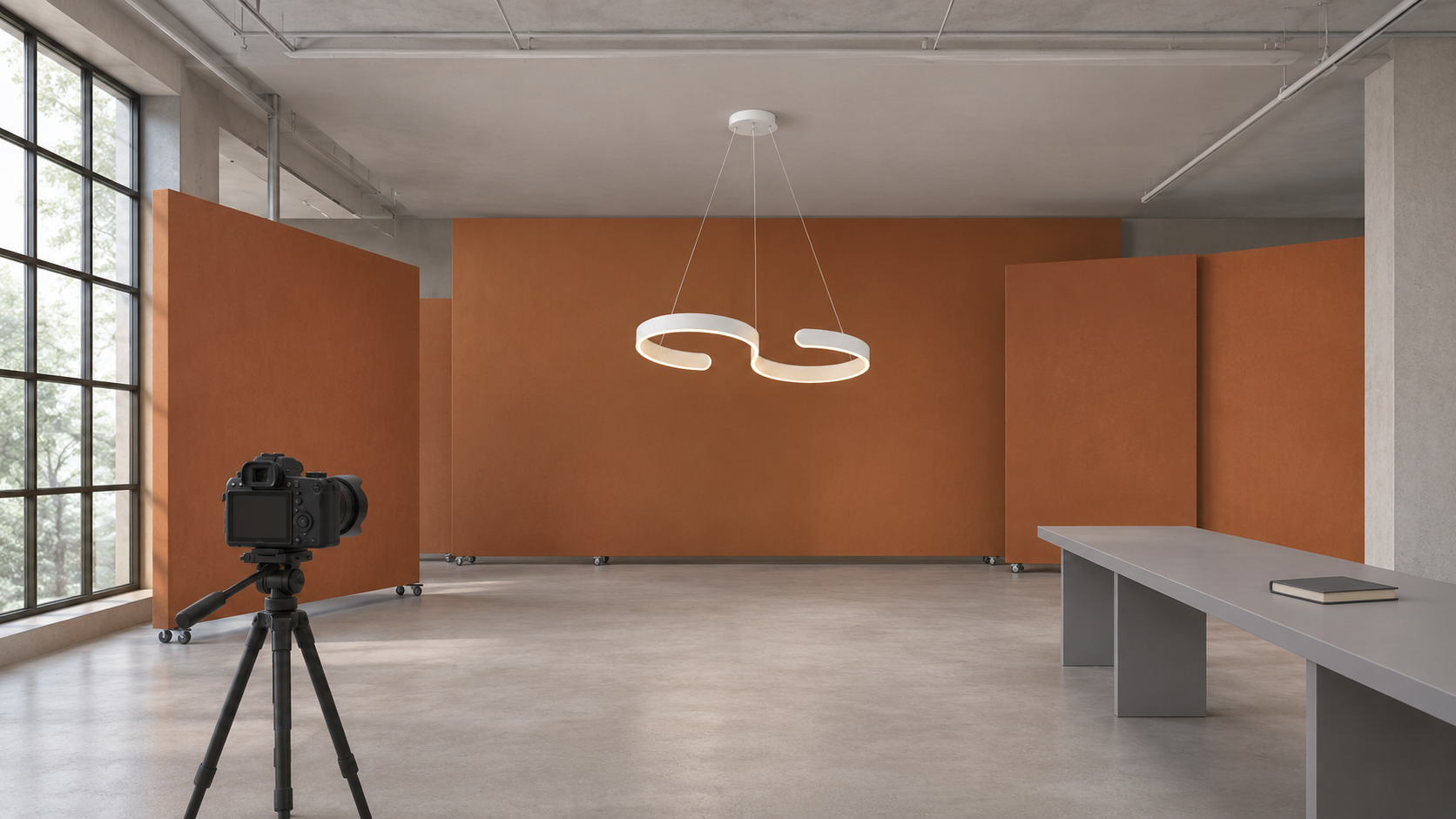
Scene illustration
A decorative pendant may appear steady in a room yet produce moving bands or pulsing brightness in a recording. If a hotel, private club or meeting space will be filmed, include the intended cameras and lighting scenes in the sample review. A visual check by eye and a clean video image answer different questions.
The problem can emerge after the room looks finished
In a hypothetical hotel interview corner, the interior designer accepts a softly illuminated custom pendant. Later, the production team records an interview at an evening setting and sees dark bands crossing the background. The room's appearance has not necessarily changed. The recording has introduced another system whose behaviour was absent from the original visual review.
Moving the lamp out of frame may change the composition, but first establish what is happening. Ask the lighting and video teams to distinguish temporal brightness variation from glare, a reflected bright source or an overexposed shade. Those problems require different investigations. A still photograph cannot demonstrate that a moving-image problem has been resolved.
Why the camera and the eye can disagree
The U.S. Department of Energy describes temporal light modulation as rapid variation in a source's intensity. Its Flicker Research page explains that driver loading, dimming level and the dimmer's output can affect the waveform. It also cautions that a metric predicting one human visual response does not necessarily predict a video camera's response. A single generic “flicker-free” description therefore needs a stated scope.
Sony's explanation of image banding shows how changing light output can interact with exposure timing across an image. Its camera examples illustrate a recording issue, not proof that every LED lamp has the same behaviour. For a lighting specification, the useful lesson is to identify both the proposed light-source configuration and the camera conditions under which the room must work.
Do not ask one successful clip to represent every camera
Start with the actual use: an installed conference camera, a regular event-production setup or short promotional recordings. These are different review scopes. Name the devices or representative recording arrangements the project team can reasonably test, rather than requiring an undefined guarantee that no camera will ever record an artefact.
Have the video specialist record the relevant camera mode, frame rate, shutter or exposure setting and any automatic adjustments used. Alongside that, identify the luminaire sample, lamp or driver configuration, control equipment and selected dimming scene. This paired record makes the clip interpretable when someone later asks which combination was accepted.
Review the normal scene and the reduced-light scenes expected in service. Keep the camera arrangement consistent while the lighting team changes the agreed lighting settings; then let the video team examine any camera-dependent changes separately. The aim is to locate the interaction, not to prescribe a universal shutter speed, dimming percentage or pass limit for every project.
If bands appear, keep the diagnosis open
Retain the original clip and the setup record. Ask the responsible specialists whether the next comparison should concern the proposed light source, driver/control combination, recording mode or another source in the room. Change one documented condition at a time where practical. Do not infer from one striped clip that the decorative housing itself must be redesigned.
A camera adjustment may be suitable for a controlled production setup, but the operator needs to know that the result depends on it. Equally, a proposed lighting-component change requires another review of the configuration. Compare the remedy with the actual operating brief: a fixed conferencing installation and a room hired to visiting film crews impose different practical expectations.
A clean recording under agreed conditions is evidence for those conditions. It is not a laboratory characterisation of all temporal light behaviour, a human-comfort assessment or a safety certificate. Where the project requires measured performance, have the lighting specialist define the appropriate data and method in addition to the recording review.
What to request with bespoke decorative lighting
Meiyun Lighting's in-house LED assembly, engineering-drawing support and pre-assembly testing provide a basis for discussing the proposed lighting configuration before production. Share the filming use and the available camera-review plan with the enquiry. Ask which source and control options are feasible for the selected design and what sample or supporting information can be agreed for that order.
Keep the accepted source, control arrangement and recording scope attached to the fixture schedule. If a component is substituted, ask whether the recorded result still represents the proposal. Our guide to defining the dimming control interface addresses the electrical integration question; the camera review adds a separate check of the intended recorded result.
For overseas hotel and commercial projects, this conversation is most useful while the custom lighting specification is still open. Agree who provides the camera, who operates the lighting sample and who accepts the recording. The accompanying scene illustration depicts a possible review setting only; it does not show an actual test, a completed project or verified camera performance of the pictured fitting.