Project Guides
Bright Table, Dark Ceiling: Choosing Where Pendant Light Goes
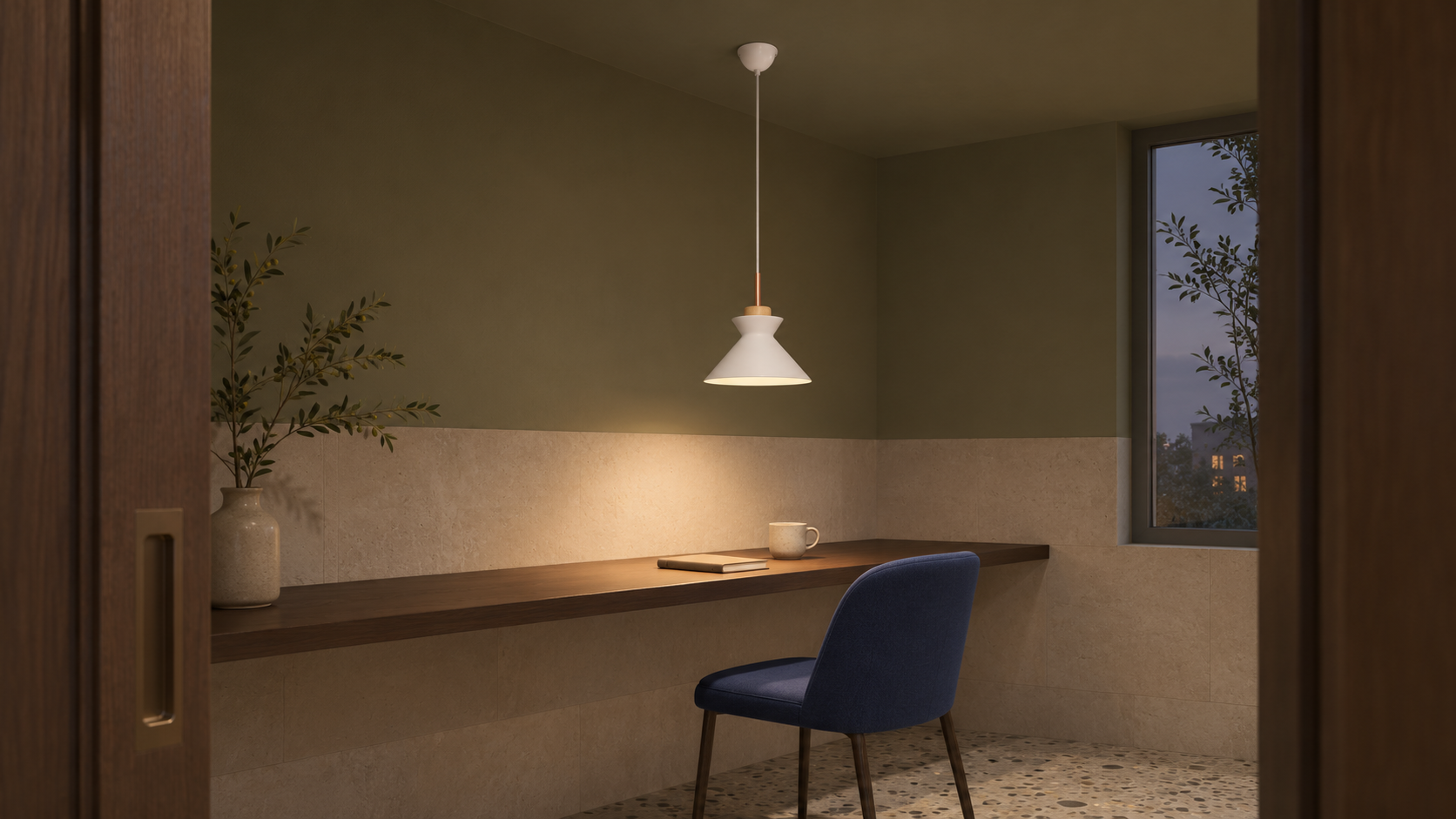
Scene illustration
A pendant can light a table while leaving the upper room comparatively dark. For hotel lounges, work alcoves and dining spaces, decide whether that contrast supports the design before asking for a brighter decorative fixture.
Look above the pool of light
Picture a small hospitality work alcove after daylight has faded. The writing surface is visible beneath a pendant, but the ceiling and upper walls recede. The designer wants the alcove to feel more open. Increasing the output is one possible question; the more useful first question is which surfaces need more light. This is a hypothetical design study, not a completed Meiyun project.
If the selected pendant directs its light mainly downwards, a brighter version still has that downward emphasis. The upper room needs a deliberate lighting decision of its own. Treat the tabletop, the pendant body and the ceiling as three different parts of the composition: a satisfactory result on one does not define the intended appearance of the others.
A luminous shade and an illuminated ceiling are different effects
A broad glowing shade can make the fixture itself prominent. Indirect lighting follows another path: light reaches a surface such as a ceiling and is reflected back into the room. ERCO explains this use of room surfaces as secondary reflectors in its guide to indirect lighting. The chosen ceiling finish therefore belongs in the lighting discussion, rather than remaining only a colour on the interior palette.
Softness is a separate design choice too. ERCO shows how diffuse and directed light produce different shadow patterns and different modelling of objects. A room can combine them. Selecting a softer-looking shade does not remove the need to decide which room surfaces should receive light and where stronger shadows are welcome.
Two ways to revise the same alcove
One route keeps the pendant as a focused decorative element over the work surface and gives another part of the lighting scheme responsibility for the upper room. The designer can explore a ceiling or wall-lighting component without asking the pendant to change its visual character. Review the combined scene, including whether the added surface light competes with the intended focal point.
Another route starts with a different distribution from the decorative fixture. Ask the manufacturer whether the proposed design can provide the required upward or broader emission, and what that would change in the visible construction. A metal enclosure, a glass component and an opening in a shade are design decisions with different visual consequences. The feasible combination needs development for the particular fitting.
These routes express different priorities. In the first, the pendant keeps a distinct role and the surrounding scheme changes. In the second, the decorative object takes on more of the room-lighting role. Neither is automatically the more elegant choice. Compare them against the desired room hierarchy: should people notice a pool at the desk, a luminous object, the architecture above it, or a deliberate combination?
Keep some shadow if it serves the room
An evenly bright ceiling is not a requirement for every hospitality interior. A lower, more intimate visual enclosure may be exactly the intended effect in a quiet corner. Write that intention into the design discussion so a comparatively dark ceiling is not automatically treated as a defect. Equally, do not use “atmospheric” to close a concern about a room that the client finds too enclosed.
A useful review begins at the room entrance, then moves to the seated position and the work surface. Look at the whole scene after daylight has reduced, using the proposed room finishes. Compare a pendant-only scene with the intended combined lighting. This is a visual design review; the project lighting professional should separately establish any required illumination, glare criteria and technical calculations.
Turn the preferred composition into a custom lighting brief
Meiyun Lighting manufactures bespoke decorative lighting and operates in-house metalworking, surface-finishing, hand-blown-glass fabrication and LED assembly processes. Send the room section, ceiling finish, intended furniture arrangement and a description of the surfaces you want to emphasise. Discuss the desired light direction alongside the pendant profile, materials and dimensions, rather than treating the exterior shape as the whole brief.
For a custom pendant, request the available optical and construction information for the proposed configuration. Do not infer a light distribution from a scene illustration or a material name. Our custom lighting production process guide describes the development stages; the design decision starts earlier, with a clear answer to what the pendant should light and what the surrounding scheme should contribute.